Milestones in Product Roadmaps: How to Track External Events, Board Meetings, and Governance Dates Without Chaos


Your board meeting is in three weeks. The CEO expects a demo of the new retention features. Squad A thinks they have six sprints to ship. Nobody told them about the demo.
This conversation happens in product organizations every week. External events—board meetings, product launches, conferences, regulatory deadlines—live in calendars, emails, or someone’s head. They don’t appear on roadmaps. Teams plan delivery work without knowing about the immovable external constraints that will suddenly demand demo-ready features, governance presentations, or compliance documentation.
Then, inevitably, someone says “Wait, we need this ready for the board meeting next week?” and teams scramble to make half-finished work presentable, cutting corners, skipping testing, and creating the exact kind of technical debt that will haunt them for the next six months.
The problem isn’t that external events exist—they’re unavoidable in any organization connected to the real world. The problem is that most roadmapping tools don’t treat milestones as first-class elements distinct from delivery work, forcing teams to either ignore external constraints entirely or awkwardly mix them with feature delivery in ways that create confusion rather than clarity.
What Are Milestones and Why Do They Matter?
In RoadmapOne , Milestones are date-specific events external to your delivery work that create planning constraints, visibility requirements, or coordination dependencies.
They’re not features you’re shipping—they’re events that happen whether you’re ready or not.
Common milestone categories include board meetings and Governance Reviews, where executives expect to see progress, understand strategic direction, and ask hard questions about resource allocation and business outcomes. These typically happen quarterly, though some organizations run monthly board rhythms or have special governance committees that meet more frequently.
Product launches represent external commitments to customers, press, or market timing that create hard deadlines for feature readiness, regardless of whether teams feel the product is truly polished. You announced the launch date three months ago. Customers expect it. Delaying destroys credibility. The milestone is fixed; the team must plan backwards from it.
Conferences and industry events create visibility moments where your company presents, demos products, or makes announcements. Whether it’s a keynote presentation, a booth demo, or a speaking session, these events demand demo-ready features on specific dates that can’t be moved because someone already bought plane tickets and booked the venue.
Regulatory and compliance deadlines represent legal or industry requirements that must be met by specific dates. GDPR compliance wasn’t negotiable. Accessibility requirements for government contracts have hard due dates. Industry certifications expire and must be renewed. These milestones come with consequences far worse than disappointed stakeholders—they come with fines, legal liability, and contract breaches.
Organizational events like all-hands meetings, strategy offsites, or quarterly planning sessions often require product teams to present roadmaps, demonstrate progress, or gather feedback that influences subsequent planning cycles.
The critical characteristic of milestones is that they’re immovable. You can adjust feature scope. You can deprioritize delivery work. You cannot move a board meeting already on the CEO’s calendar, postpone a conference where you’re the keynote speaker, or negotiate with regulators about compliance deadlines.
This immovability makes milestones planning constraints of the highest order. Teams must plan backwards from milestones, ensuring that whatever needs to be ready by that date actually is ready—or explicitly deciding not to present, demo, or commit to something that isn’t truly achievable.
The Milestone Visibility Problem: Why Roadmaps Hide What Matters Most
Most product teams track milestones somewhere. The problem is where they track them and how (or whether) that information connects to actual roadmap planning.
The Email/Calendar Problem
Many milestones live exclusively in calendar invites, email threads, or verbal commitments made in hallway conversations. The product manager knows about the Q3 board meeting. The designer heard about the conference demo. The engineering lead vaguely remembers someone mentioning a regulatory deadline. But none of this information appears in any system the entire team uses for planning delivery work.
The result is predictable: teams plan sprints based purely on feature priority without accounting for external constraints they don’t know about or haven’t internalized. Then someone mentions the upcoming board meeting, and teams realize they have two weeks instead of six to make features demo-worthy. Panic ensues. Quality suffers. Technical debt accumulates.
The Jira Workaround Problem
Some teams try to represent milestones in Jira by creating fake “milestone tickets” or epics with due dates. This creates several problems that undermine both milestone visibility and delivery tracking.
First, milestone tickets mix with delivery work in backlogs, making it unclear what represents features being shipped versus events happening externally. When you filter by sprint or status, milestones appear alongside actual work items, cluttering views and making it harder to see what the team is actually building versus what’s happening in the outside world.
Second, milestone tickets often end up in the wrong workflow states. A board meeting doesn’t move from “To Do” to “In Progress” to “Done” the way a feature does. It just… happens. On a specific date. Whether you’re ready or not. Forcing milestones into delivery workflows creates cognitive dissonance and makes Jira boards harder to interpret.
Third, milestone tickets don’t naturally map to teams versus squads. A board meeting affects multiple teams simultaneously. A product launch might involve three different squads. Creating milestone tickets at the squad level duplicates information. Creating them at a higher level loses squad-specific context. There’s no clean model.
The Gantt Chart Illusion Problem
Roadmap tools that use timeline or Gantt chart views often allow milestones to appear as vertical lines or diamond symbols on the timeline. This looks great in presentations. It’s also deeply misleading about the relationship between milestones and capacity planning .
Gantt charts hide capacity constraints by showing unlimited parallel work on a timeline—a problem we explore in detail in Grid vs Timeline: Why Squad×Sprint Grids Reveal Capacity Truth . Adding milestone markers to a Gantt chart creates the visual impression that teams have planned for the milestone, when in reality the chart shows no connection between squad capacity, sprint allocations, and milestone readiness.
You can have a beautiful Gantt chart with a “Board Meeting” milestone on March 15th and three features scheduled to complete March 10th-12th, without any visibility into whether those features will actually be demo-ready or whether squads even have capacity allocated to polish them for presentation quality.
The timeline view with milestone markers creates false confidence. It looks like someone planned for the board meeting. In reality, nobody verified that the features supposedly ready for demo are actually allocated to squads with capacity to deliver them.
Why Milestones Belong on Team Rows, Not Squad Allocations
RoadmapOne solves the milestone visibility problem by treating milestones as first-class roadmap elements that appear on team rows, distinct from squad-level work allocations.
This distinction matters because milestones and allocations represent fundamentally different types of planning information with different characteristics and different consumers.
Squad allocations represent capacity assignments—specific squads working on specific objectives during specific sprints. Allocations consume capacity. They’re tactical. They’re where squads actually do work. When you look at a squad row in a roadmap grid, you’re seeing: “This squad is working on this objective during this sprint, consuming this much capacity.”
Milestones represent external events—dates when something happens in the outside world that the organization must be ready for. Milestones don’t consume capacity. They’re strategic. They’re coordination points. When you look at a team row with milestones, you’re seeing: “On this date, this organizational unit (potentially including multiple squads) needs to demonstrate something, present something, or achieve some external requirement.”
Putting milestones on team rows creates several advantages that improve both visibility and planning quality.
First, it prevents confusion between delivery and events. When you look at a squad row, everything you see represents work that squad is doing. When you look at a team row, you see organizational events that multiple squads might need to coordinate around. There’s no mixing of “features being delivered” with “external events happening.”
Second, it enables multi-squad coordination. A board meeting typically involves an entire team or organization, not just one squad. Placing the milestone on the team row makes it visible to all squads within that team, helping everyone understand the constraint they’re all planning around simultaneously.
Third, it supports hierarchical milestone planning. Some milestones affect the entire organization (company-wide product launch). Some affect a specific tribe or team (team quarterly review). Some affect individual squads (squad-specific demos or presentations). By allowing milestones at different levels of the team hierarchy, you can represent the appropriate scope of each external event.
Fourth, it improves stakeholder communication. When executives or cross-functional partners view the roadmap, they immediately see external events that create hard constraints, separate from the fluid planning of squad-level delivery work. This separation helps non-technical stakeholders understand the difference between “features we’re building” and “dates when things need to be ready.”
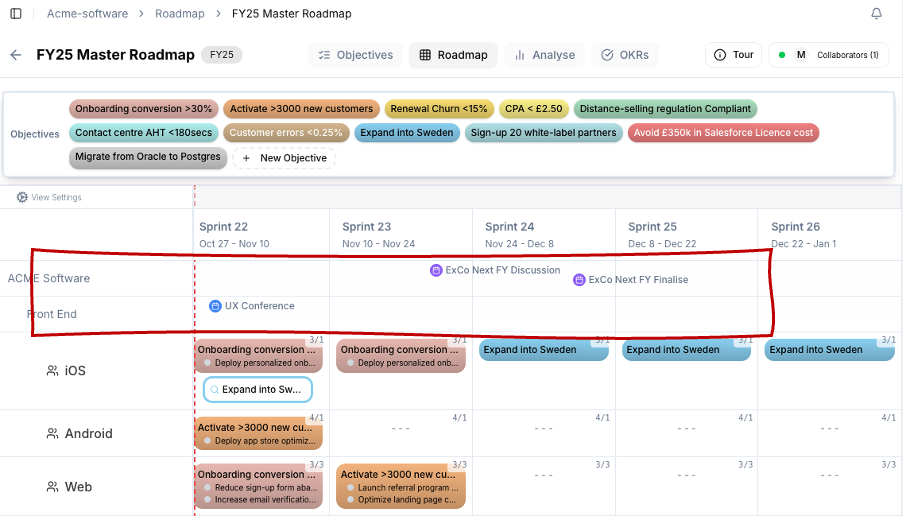 Milestones appear on team rows in RoadmapOne, distinct from squad-level work allocations, creating clear visual separation between external events and delivery work.
Milestone Types: Customizable Categories That Reflect Your Organization’s Rhythm
Different organizations have different types of external events that create planning constraints. RoadmapOne provides customizable milestone types that let you categorize and visualize milestones in ways that match your organizational reality.
Common Milestone Types
Product Launches represent public commitments to ship features or release new products on specific dates. These typically come with marketing campaigns, press releases, customer communications, and cross-functional coordination across product, engineering, design, marketing, sales, and customer success. The milestone marks the date when customers expect the product to be available, regardless of internal readiness.
Board Meetings and Governance Reviews are quarterly or monthly events where executive teams present to boards of directors, investors, advisory boards, or internal governance committees. These meetings demand demo-ready features, strategic roadmap updates, and answers to hard questions about resource allocation and business outcomes. The dates are immovable because board members scheduled them months in advance.
Conferences and Industry Events include keynote presentations, booth demos, speaking sessions, and industry trade shows where your company needs to demonstrate products, announce features, or maintain competitive visibility. These create hard deadlines for demo-ready features that work reliably under presentation conditions.
Regulatory and Compliance Deadlines represent legal or industry requirements with specific due dates. GDPR compliance, accessibility certifications, industry-specific regulations, and contract-mandated requirements all come with dates you cannot miss without serious consequences.
Organizational Events like all-hands meetings, strategy offsites, quarterly planning sessions, or company-wide demos create moments where product teams need to present progress, gather feedback, or align on strategic direction with broader organizational stakeholders.
Customer Commitments include contractual delivery dates, pilot program milestones, or customer-specific deadlines where specific customers were promised specific functionality by specific dates as part of sales contracts or partnership agreements.
Planning Backwards from Milestones: Ensuring Readiness Without Panic
The value of making milestones visible isn’t just awareness—it’s enabling teams to plan backwards from immovable constraints to ensure readiness without last-minute scrambling.
Planning backwards means starting with the milestone date and working in reverse to identify what needs to happen when to ensure the team is genuinely ready for that external event.
Let’s walk through a concrete example: a board meeting on March 15th where the CEO expects to demo new retention features.
Milestone: Board Meeting, March 15th
Working backwards from March 15th, the product team identifies the preparation timeline:
March 14th (1 day before): Final rehearsal with CEO. Demo script finalized. Edge cases tested. Backup plans ready if something breaks during the live demo.
March 8-13th (Sprint 12): Polish sprint. Features are feature-complete but need UX polish, error message refinement, edge case handling, and performance optimization to be demo-worthy. Squad A dedicates 50% capacity to polish work specifically for demo readiness.
Feb 23-Mar 7 (Sprints 10-11): Delivery sprints. Core retention features being built. Squad A allocated 100% to retention objective. Key results defined: reduce time-to-first-value from 48 hours to 4 hours, increase activation rate from 40% to 65%.
Feb 9-20 (Sprint 9): Discovery sprint. Validate retention assumptions with customer interviews, prototype testing, and business case analysis. Commit to specific key results that will move the retention objective.
This backwards plan makes explicit that the team needs to start discovery on February 9th—five weeks before the board meeting—to have any chance of delivering demo-ready retention features by March 15th.
Without the milestone visible on the roadmap, teams might schedule discovery for mid-March (because nobody told them about the early March deadline), making it literally impossible to have working features for the board meeting.
Planning backwards also forces honest conversations about what’s actually achievable. If today is February 1st and the board meeting is March 15th, you have six weeks. Looking at the backwards plan, you need five weeks minimum. That means you have one week of buffer. Is that realistic? Or should someone tell the CEO now that retention features won’t be demo-ready by March 15th, giving leadership time to adjust expectations or change the board agenda?
These conversations are uncomfortable. They’re also infinitely better than discovering two days before the board meeting that features aren’t ready and there’s no time to fix it.
Cross-Functional Coordination Around External Events
Milestones don’t just affect product teams—they typically require cross-functional coordination involving marketing, sales, customer success, legal, finance, and executive leadership. Making milestones visible on the roadmap helps these cross-functional stakeholders understand when they need to contribute, what they need to prepare, and how their work coordinates with product delivery timelines.
Consider a product launch milestone. Marketing needs to prepare launch campaigns, write press releases, create customer communications, and coordinate analyst briefings. Sales needs training on new features, updated pitch decks, and answers to customer questions. Customer success needs documentation, support training, and migration plans for existing customers. Legal might need to review terms of service updates or privacy policy changes. Finance needs revenue projections and pricing model updates.
All of this cross-functional work must coordinate around the same immovable launch date. When the launch milestone appears on the product roadmap, each function can see exactly when they need to be ready and plan their work accordingly.
Marketing can see: “The retention features launch March 30th. We need finished product screenshots by March 15th for launch materials. Product team, can you provide those?” And the product team can either confirm (“Yes, features will be demo-ready by March 15th—you can take screenshots then”) or push back (“Features won’t be visually polished until March 25th—can your launch materials wait, or should we move the launch date?”).
These coordination conversations happen proactively, weeks in advance, when there’s still time to adjust plans or negotiate deadlines. Contrast this with the alternative: marketing discovers two days before the planned launch that features aren’t ready, scrambles to push back all the launch materials they already finalized, and damages relationships with press and analysts who were expecting the announcement.
Milestone visibility enables proactive cross-functional coordination rather than reactive firefighting.
Using Milestones to Prevent “Surprise We Have a Demo Tomorrow” Scenarios
Every product manager has experienced the surprise demo request: an executive mentions in passing that they’re showing the product to an important customer tomorrow, or a sales engineer commits to demoing unreleased features to close a deal, or a conference organizer confirms your speaking slot where you promised to showcase new capabilities—and nobody told the product team until now.
These surprises happen because milestones live in different people’s calendars and email threads rather than in a shared, visible planning system that product teams actually use for roadmap planning.
The solution is making milestones first-class roadmap elements that everyone sees and acknowledges. When a sales leader schedules a high-stakes customer demo for next Thursday, that demo appears as a milestone on the roadmap. Product managers see it. Engineering leads see it. Designers see it. Everyone knows this external commitment exists and can plan accordingly—or raise concerns immediately if the commitment isn’t achievable.
This visibility also creates organizational discipline around making external commitments. Before a sales leader promises a demo next week, they might actually look at the roadmap and see whether relevant features are scheduled for completion. Before a marketing leader commits to a launch date, they might verify with product whether that timeline is realistic given current allocations.
Milestone visibility doesn’t prevent all surprise demos—sometimes urgent opportunities justify scrambling. But it dramatically reduces the frequency of surprises by making external commitments visible to the teams responsible for delivering on them.
How RoadmapOne Milestone Types Work
RoadmapOne implements milestones as customizable types that can be created, edited, and managed through workspace settings, then applied to specific team rows at specific dates within roadmaps.
Creating and Managing Milestone Types
Workspace administrators access milestone type settings to define the organizational categories of external events that create planning constraints. Each milestone type has a name (e.g., “Board Meeting,” “Product Launch,” “Conference”), a color for visual differentiation, and an icon that makes the milestone type instantly recognizable when viewing the roadmap grid.
Organizations typically start with a few core milestone types, then add specialized categories as planning needs evolve. A startup might begin with just “Board Meeting” and “Product Launch.” A regulated financial services company might add “Compliance Audit,” “Regulatory Filing,” and “Security Review.” A company with heavy conference presence might track “Keynote Presentation,” “Booth Demo,” and “Speaking Session” as distinct types with different preparation requirements.
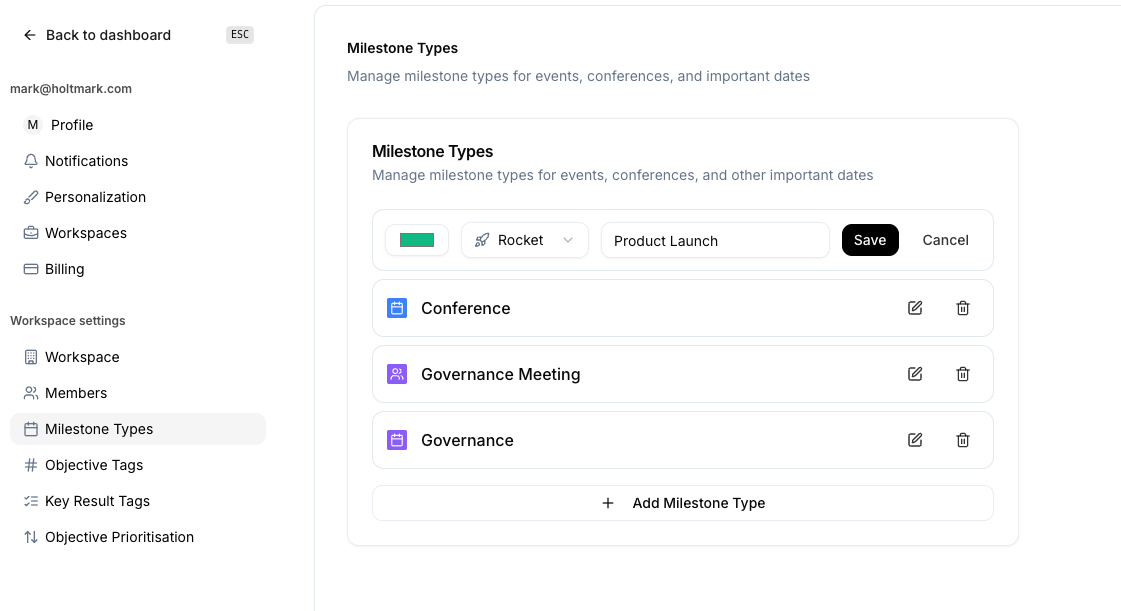 The Milestone Types settings page allows workspace administrators to create, edit, and customize milestone categories with specific names, colors, and icons that match organizational planning needs.
Adding Milestones to Roadmap Team Rows
Once milestone types are defined at the workspace level, product managers and team leads can add specific milestone instances to team rows within roadmaps.
Adding a milestone is as simple as double-clicking on a team row at the appropriate date and selecting “Add Milestone” from the context menu. A modal appears where you select the milestone type, enter the milestone name, and set the date. The milestone then appears on the team row, positioned at that date, with the color and icon from the milestone type definition.
Milestones can be added to any level of the team hierarchy. Add a milestone to the root organization level to represent company-wide events like all-hands meetings. Add a milestone to a specific team row to represent team-level governance reviews. Add a milestone to a lower-level team for squad-specific demos or presentations.
This flexibility ensures that milestone scope matches event scope—company-wide milestones visible to everyone, team-specific milestones visible to affected teams, squad-specific milestones positioned where relevant.
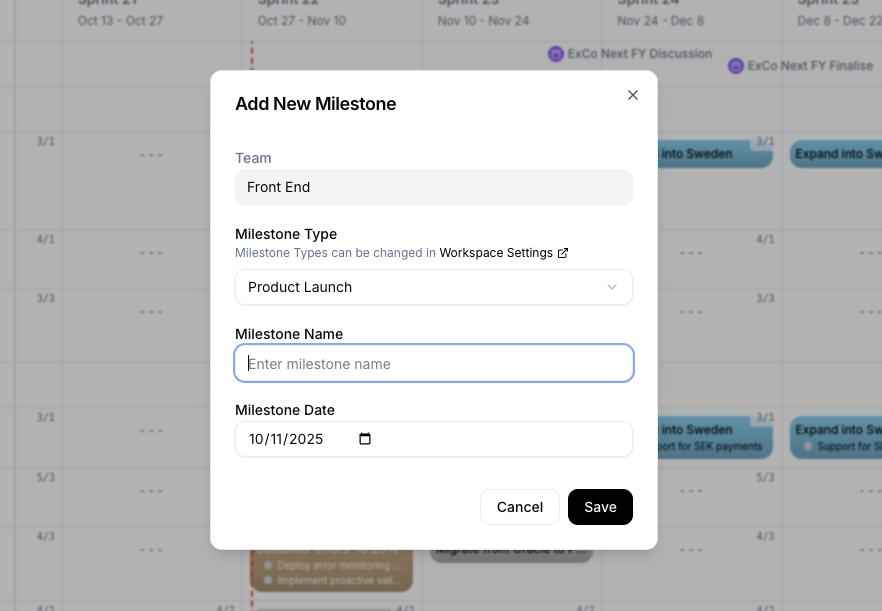 The Add Milestone modal allows users to select milestone type, enter a name, and set the date. Milestones then appear on team rows at the specified date with type-specific colors and icons.
Visual Representation on the Roadmap Grid
Milestones appear as distinct visual elements on team rows within the roadmap grid, using the color and icon from their milestone type. This visual representation creates immediate recognition of external events and their timing relative to squad-level delivery work.
When viewing the roadmap grid, milestones stand out from work allocations because they appear on team rows (not squad rows) and use distinctive iconography rather than the colored blocks that represent allocated work. This visual separation reinforces the conceptual difference between external events (milestones) and delivery work (allocations).
Hovering over a milestone reveals additional details in a tooltip: milestone name, type, date, and any associated description or notes. Double-clicking a milestone opens the edit modal where details can be updated or the milestone can be deleted if plans change.
The grid’s date-based columns ensure that milestones appear chronologically aligned with the sprints they correspond to, making it immediately clear which delivery work is happening in the same time period as which external events.
Real-World Milestone Scenarios
Let’s explore how different types of organizations use milestones to improve roadmap planning and stakeholder coordination.
SaaS Company: Quarterly Board Meetings
A growth-stage SaaS company uses quarterly board meetings as major planning milestones. Each quarter, the CEO presents product progress, strategic direction, and key metrics to board members and investors.
Product teams mark each board meeting as a milestone on the organizational root level, making it visible to all teams and squads. Then they plan backwards from each board date to ensure that features scheduled for demo are actually ready for presentation.
For the Q2 board meeting on June 15th, product teams identify which strategic initiatives should be highlighted (retention improvements, enterprise features, international expansion). Each relevant team ensures their allocations include polish sprints in late May/early June to make features demo-worthy by mid-June. Teams might also create scenario roadmaps to model what-if alternatives for the board presentation.
This backwards planning prevents the common scenario where teams think they have the full quarter to ship retention features, only to discover in mid-June that the board meeting is tomorrow and nothing is demo-ready.
Healthcare Tech: Regulatory Compliance Deadlines
A healthcare technology company faces strict regulatory compliance deadlines for HIPAA, FDA software validation, and state-level health data privacy requirements. Missing these deadlines isn’t just embarrassing—it’s legally problematic and blocks customer contracts.
Product teams mark each regulatory deadline as a milestone with a distinctive “Compliance Deadline” type colored in red to signal importance. Planning backwards from these milestones, teams allocate discovery sprints to understand requirements, delivery sprints to implement necessary controls, and validation sprints to gather documentation and test compliance measures.
For an FDA software validation deadline on September 30th, the team working on clinical decision support features allocates June-August to implementing required validation controls, automated testing, and audit logging. They mark July 15th as an internal milestone for “Compliance Review” where legal and quality assurance teams verify that implementation meets FDA requirements, giving the team two months to address any gaps before the hard September deadline.
This milestone-driven planning ensures regulatory requirements don’t get lost among feature work and only surface at the last minute when it’s too late to properly address them.
Enterprise Software: Customer Contractual Commitments
An enterprise software company sells large contracts with specific delivery commitments: “Feature X will be available by Q3 2025” or “Integration with System Y will be complete by August 15th.” These contractual commitments create hard milestones—missing them means contract breaches, lost revenue, and damaged customer relationships.
Sales teams work with product teams to mark customer commitment dates as milestones on relevant team roadmaps. Before sales commits to new delivery dates in contracts, they check the roadmap to verify that existing allocations support the proposed timeline.
For a major customer contract promising API integration by October 1st, the team responsible for integrations sees this milestone on their roadmap and plans accordingly. Discovery sprint in July to understand the customer’s integration requirements. Delivery sprints in August-September to build the integration. Buffer time in late September for edge case testing and documentation.
If mid-August arrives and the team realizes the integration is more complex than expected, they raise concerns immediately—giving sales and customer success teams six weeks to renegotiate timelines or adjust scope rather than discovering the problem three days before the contractual deadline.
Common Mistakes with Milestone Planning
Even teams that track milestones often make predictable mistakes that undermine the value of milestone visibility.
Mistake 1: Not Planning Backwards from Milestones
Teams mark milestones on the roadmap but don’t actually plan delivery work around them. The board meeting milestone appears on June 15th. Teams plan delivery sprints that end June 12th. Nobody allocates polish capacity to make features demo-ready. Then on June 14th someone realizes nothing is presentable and teams scramble to create a demo.
The solution is explicit backwards planning: identify the milestone, determine what readiness means for that milestone (demo-quality? production-ready? documentation complete?), and allocate capacity in sprints leading up to the milestone to ensure actual readiness.
Mistake 2: Not Updating Milestones When Plans Change
External events change. Board meetings get moved. Conference dates shift. Customer commitments get renegotiated. Teams mark the original milestone on the roadmap but never update it when plans change.
This creates dangerous divergence between the roadmap milestone and reality. Teams plan around a board meeting on June 15th that actually moved to June 30th, wasting polish capacity in early June and missing the actual preparation timeline for late June.
The solution is treating milestones as first-class roadmap elements that must be updated whenever external events change, just as you’d update allocations when delivery plans change.
Mistake 3: Too Many Milestones
Some teams go overboard marking every conceivable event as a milestone: every sprint review, every stakeholder check-in, every demo opportunity. The roadmap becomes cluttered with milestone markers that obscure the truly important external constraints.
The solution is disciplined milestone creation—mark only the external events that genuinely constrain planning or require significant cross-functional coordination. Sprint reviews are regular ceremonies, not milestones. Quarterly board meetings are milestones. Weekly stakeholder demos are ceremonies. Product launches are milestones.
Mistake 4: Wrong Milestone Scope
Teams mark company-wide events as squad-level milestones or team-specific events as organizational milestones, creating confusion about who the milestone affects and who needs to plan around it.
The solution is matching milestone scope to event scope: company-wide milestones at the organizational root level, team-specific milestones on team rows, squad-specific events (if truly milestone-worthy) at squad level. This ensures visibility is appropriate to the event’s actual scope.
Conclusion: Making External Constraints Visible
Product roadmaps that ignore external constraints create planning illusions where teams build unrealistic delivery timelines disconnected from the immovable events they must actually coordinate around.
Board meetings happen whether you’re ready or not. Product launches occur on announced dates regardless of internal preparedness. Regulatory deadlines arrive with legal consequences for missing them. Conferences require demos on specific dates that can’t be moved because venues are booked and attendees have plane tickets.
These external constraints are the immovable rocks around which product delivery must navigate. Making them invisible doesn’t make them go away—it just ensures teams discover them too late to plan effectively.
RoadmapOne treats milestones as first-class roadmap elements, visually distinct from delivery work, positioned on team rows where they provide visibility without creating confusion with squad-level allocations.
Customizable milestone types let organizations reflect their actual external constraints—board meetings, product launches, compliance deadlines, conference demos—with colors and icons that make each type immediately recognizable.
Planning backwards from milestones transforms them from surprise deadlines into strategic planning constraints that teams account for proactively, allocating discovery, delivery, and polish capacity to ensure genuine readiness rather than last-minute scrambling.
Cross-functional stakeholders see the same milestones on the same roadmap, enabling coordinated planning across product, engineering, marketing, sales, legal, and leadership rather than each function operating with different assumptions about critical dates.
That’s not just better milestone tracking. That’s honest planning that accounts for the reality of external constraints, stakeholder expectations, and organizational commitments that can’t be moved by wishful thinking about delivery timelines.
References and Further Reading
- Product Discovery in Roadmaps - How to plan discovery capacity around milestone constraints
- Time-Boxed Discovery - Concentrated discovery sprints that fit between milestones
- Objective Prioritisation Frameworks - Prioritizing work around milestone readiness
- Marty Cagan, EMPOWERED: Ordinary People, Extraordinary Products - Planning around stakeholder commitments and business constraints