Feature Factory to Outcome Team: Breaking the Pattern That's Killing Your Product

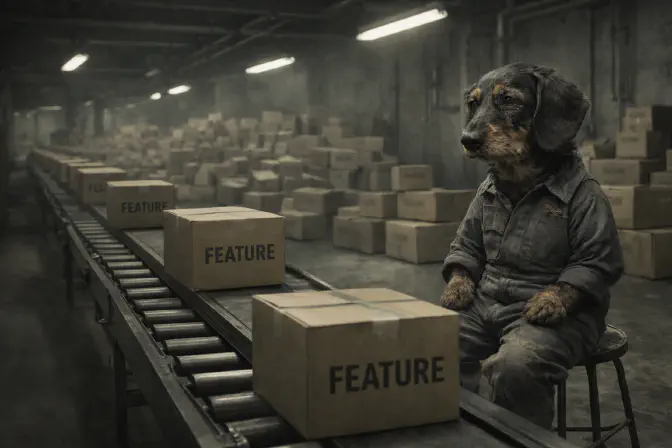
Your team shipped 47 features last quarter. Your engineers worked late, your PMs wrote specs, your designers crafted mockups. The roadmap is green. Everyone celebrated the releases.
And yet—your key metrics haven’t moved. Customer satisfaction is flat. Churn hasn’t improved. Revenue growth is unchanged.
You, my friend, are running a feature factory.
TL;DR: I’ve inherited, created, and rescued teams from feature factory mode. The symptoms are always the same: exhaustion without achievement, activity without impact, shipping without learning.
The hardest part isn’t recognising the pattern—it’s admitting your team is in it. Nobody wants to acknowledge that the last year of hard work didn’t move the needle. But until you admit it, you can’t fix it.
What Is a Feature Factory?
The term “feature factory” was coined by John Cutler to describe product teams that:
- Measure success by output, not outcomes
- Celebrate shipping, not achieving
- Take feature requests rather than solving problems
- Have backlogs that only grow, never shrink
- Feel busy but not purposeful
At its core, a feature factory treats product development like manufacturing: raw materials (requirements) go in, finished goods (features) come out. The more you produce, the better you’re doing.
Except software isn’t manufacturing. More features doesn’t equal more value. Sometimes it equals more complexity, more bugs, more support burden, and more confused users.
The Four Symptoms I’ve Seen
In my career as a CTO and product leader, I’ve experienced every symptom of feature factory mode—sometimes on teams I inherited, sometimes on teams I inadvertently created.
Symptom 1: Shipping Without Impact
The most obvious sign: features ship, metrics don’t move.
You launch a new onboarding flow. Activation doesn’t improve. You ship a recommendation engine. Average order value stays flat. You redesign the dashboard. NPS doesn’t budge.
Each feature was someone’s hypothesis about what would work. But nobody tracked whether it actually worked. The definition of “done” was “deployed to production,” not “achieved the intended result.”
When I ask feature factory teams “what happened after you shipped X?"—they don’t know. They’ve already moved on to the next feature.
Symptom 2: No Outcome Ownership
In a healthy team, someone owns the outcome: “I’m responsible for improving conversion.”
In a feature factory, people own features: “I’m building the new checkout flow.”
The difference is subtle but profound. Feature ownership ends when the feature ships. Outcome ownership continues until the metric moves—or you’ve learned why it won’t and pivoted to something else.
I’ve seen product managers list 15 shipped features on their annual review without a single metric improvement to show for it. That’s feature factory in its purest form.
Symptom 3: Backlog-Driven Roadmap
Ask a feature factory team where their roadmap comes from. The answer is usually: “The backlog.”
The backlog is full of feature requests from customers, stakeholders, and historical accumulation. The roadmap is just “top of backlog” with dates attached.
Nobody asks: “What outcome would this feature achieve?” Nobody validates: “Is this the best way to achieve that outcome?” The backlog became the roadmap, and the roadmap became a to-do list.
Roadmaps should be strategic. Backlogs are tactical. When the backlog IS the roadmap, strategy has been abandoned.
Symptom 4: Engineering Exhaustion
Here’s the human cost: engineers are burnt out.
They’re working hard, shipping regularly, but nothing feels meaningful. Every feature is disconnected from impact. They know their code is running in production, but they don’t know if it matters.
I’ve seen engineering teams with low morale despite hitting every deadline. They’re not tired from the work—they’re tired from the meaninglessness. They joined to build products that change things. Instead, they’re shipping features that nobody measures.
When engineers start asking “why are we building this?” and the only answer is “because it’s next on the roadmap”—you’ve lost them.
How Feature Factories Form
Nobody sets out to create a feature factory. They emerge from well-intentioned decisions:
The Sales-Driven Origin
Sales closes a deal with a custom feature promise. Then another. Then another. Before long, the roadmap is just sales commitments, each disconnected from strategy.
The Stakeholder-Driven Origin
Stakeholders have ideas. Good ones, sometimes. But when every stakeholder idea becomes a roadmap item, the roadmap becomes a political document, not a strategic one.
The Technical-Debt-Avoidance Origin
The team has technical debt but nobody wants to prioritise it. So they keep shipping features on top of shaky foundations, going faster in the wrong direction.
The Success-Theater Origin
Leadership wants to show progress. Features are visible progress. “We shipped 47 features” sounds better than “We’re still working on improving conversion.” So the team optimises for visible output.
The Fear-of-Saying-No Origin
Saying “no” to requests is hard. Saying “it’s on the backlog” is easy. The backlog becomes infinite, the roadmap becomes whatever floats to the top, and nobody ever actually says no.
The Cost of Feature Factory Mode
The costs are real and cumulative:
Strategic Drift
Without outcome focus, you’re building whatever’s next without knowing if it matters. Over time, the product becomes a Frankenstein of features without coherent purpose.
Opportunity Cost
Every feature built is another feature not built. If the features you’re shipping don’t move metrics, you’re wasting capacity that could go toward features that might.
Technical Debt Acceleration
Features add complexity. Without the discipline of outcome focus, teams ship features they later realise weren’t needed—but the complexity remains.
Talent Loss
The best engineers want to build meaningful products. When they realise they’re in a feature factory, they leave for teams with outcome focus. The engineers who stay are those who’ve accepted the factory model—or haven’t noticed.
Customer Confusion
More features isn’t better for users. It’s often worse—more complex interfaces, more to learn, more to go wrong. Feature factories make products that are feature-rich and user-poor.
Breaking the Pattern
The path from feature factory to outcome team requires changes at every level:
Change 1: Reframe the Roadmap
Stop putting features on the roadmap. Put outcomes instead.
“Build recommendation engine” becomes “Increase average order value by £15.”
The feature might still be the solution—but now it’s a hypothesis, not a commitment. If recommendations don’t increase AOV, you try something else. The outcome is the commitment, not the feature.
For a detailed guide, see Outcome-Based Roadmaps .
Change 2: Define Success Before Building
Before any significant work begins, define:
- What outcome are we trying to achieve?
- How will we measure success?
- What does failure look like?
This sounds obvious but feature factories skip it. They build first and (don’t) measure later.
Change 3: Own Outcomes, Not Features
Assign ownership at the outcome level—this is where OKRs connect naturally to roadmaps :
“Team A owns conversion optimisation” (outcome ownership) Not: “Team A is building the new checkout” (feature ownership)
Outcome ownership means the team is accountable until the metric moves. They might build three features, or pivot entirely, or discover a non-engineering solution. The outcome is their responsibility.
Change 4: Celebrate Achievement, Not Shipping
This is cultural. Leadership must model it.
Instead of: “Congratulations on launching the new feature!” Try: “Congratulations on improving conversion from 15% to 22%!”
If the feature launched but the metric didn’t move, that’s not success. It’s an experiment that didn’t work. Learn from it and try again.
Change 5: Kill the Infinite Backlog
The backlog should not be a permanent parking lot.
Set a capacity: “Our backlog contains no more than 6 months of work.” Anything older gets archived or deleted. If it wasn’t important enough to do in 6 months, it’s not important.
This forces ongoing prioritisation instead of endless accumulation.
The Leadership Conversation
Breaking feature factory mode requires executive support. Here’s how to make the case:
What you’re doing now: “We’re shipping features.”
What’s wrong with it: “We’re not measuring whether those features achieve anything.”
What we should do: “Commit to outcomes instead of features. Measure success by metric improvement, not deployments.”
The risk of not changing: “We’ll keep burning engineering capacity on features that don’t move the business.”
The risk of changing: “We might discover that some past features didn’t work. We’ll have to admit that and learn from it.”
Most executives get it when framed this way. They’re not invested in features—they’re invested in results. Feature factory mode is as frustrating for them as it is for the team.
What Outcome Teams Look Like
Here’s the contrast:
| Feature Factory | Outcome Team |
|---|---|
| Roadmap = feature list | Roadmap = outcome commitments |
| Success = shipped | Success = metrics moved |
| Teams own features | Teams own outcomes |
| Backlogs grow forever | Backlogs are constrained |
| Engineers are exhausted | Engineers are purposeful |
| Customers get more features | Customers get better solutions |
The work isn’t necessarily harder. But it’s more meaningful—and more effective.
The Discovery Layer
Outcome teams need discovery to work. You can’t commit to outcomes and then build predetermined features.
The flow becomes:
- Commit to outcome (roadmap)
- Discover solutions (research, prototypes, experiments)
- Build what works (delivery)
- Measure impact (outcomes)
- Iterate or move on
Discovery isn’t optional overhead—it’s how outcome teams determine what to build. See our series on product discovery for more.
The 90-Day Transition
If you’re in feature factory mode, here’s a 90-day transition plan:
Days 1-30: Baseline and Awareness
- List your key business metrics (conversion, retention, revenue per user, etc.)
- Note current values—this is your baseline
- For each in-progress feature, ask: “What metric should this improve?”
- For features that can’t answer: flag them for review
Days 31-60: Reframe Current Work
- Don’t stop work in progress—but add outcome definitions
- “This feature should improve X from Y to Z”
- Set measurement in place before shipping
- Start measuring impact of recent releases
Days 61-90: Shift the Pipeline
- New roadmap items must be outcomes, not features
- Teams propose solutions to outcomes, not features to build
- Review meetings focus on metric progress, not delivery status
- Celebrate first outcome achievement loudly
By day 90, you should see:
- At least one outcome achieved (or learned from)
- Teams talking about metrics, not just features
- Backlog items connected to outcomes
- Cultural shift beginning
Common Objections
“Our stakeholders want features, not outcomes”
They think they want features. What they actually want is their problem solved. Translate: “You want the recommendation engine because you believe it will increase AOV. Let’s commit to increasing AOV—and validate whether recommendations are the right approach.”
“We can’t measure everything”
You can’t measure everything, but you can measure enough. If an initiative truly can’t be measured, ask: “How will we know if it worked?” If you can’t answer, you shouldn’t build it.
“Our engineers just want to code”
Good engineers want to build things that matter. Ask them: “Would you rather ship features that nobody uses, or ship fewer features that actually move metrics?” I’ve never met an engineer who chose the first option.
“We’ll ship less”
Maybe. But you’ll achieve more. Would you rather ship 50 features that don’t move metrics, or 20 features that do?
Conclusion
Feature factories aren’t evil—they’re stuck. They’re teams that optimised for the wrong metric (output) and need to reorient around the right one (outcomes).
The path out isn’t complicated:
- Stop putting features on roadmaps
- Start putting outcomes
- Measure whether you achieve them
- Celebrate achievement, not shipping
The hardest part is admitting you’re in the pattern. Once you do, the path forward is clear.
Your team isn’t lazy or incompetent. They’re just building the wrong things for the wrong reasons. Give them outcomes to pursue, and watch what they can achieve.