GIST Framework: You Probably Already Have This Under Different Names
Take the Confidence Meter, Skip the Extra Terminology

This is one of RoadmapOne ’s articles on Objective Prioritisation frameworks .
GIST—Goals, Ideas, Steps, Tasks—is Itamar Gilad’s answer to the feature factory problem. Instead of jumping from vague strategy to detailed task lists, GIST introduces layers: Goals define what you’re trying to achieve, Ideas compete to serve those goals, Steps validate ideas through time-boxed experiments, and Tasks execute the validated steps.
The appeal is a complete hierarchy from strategy to execution in one coherent framework. The reality is that most organisations already have these layers under different names—and GIST adds vocabulary without necessarily adding value.
GIST provides a useful mental model for product discovery, particularly the confidence meter concept for tracking idea validation over time. But if you already have OKRs and a prioritisation framework like RICE or BRICE, GIST adds overhead without proportional benefit. The best approach: use GIST’s thinking during discovery, then map outputs into OKRs + RoadmapOne for planning and JIRA for execution. Don’t adopt GIST as your operating system.
The Four Layers of GIST
Goals: The Strategic North Star
Goals in GIST are equivalent to Objectives in OKRs—measurable outcomes that define success. “Increase monthly active users by 40%” or “Reduce churn to under 5%” or “Achieve SOC 2 compliance by Q3.”
Goals should be:
- Outcome-focused — what changes in the world, not what you build
- Measurable — specific metrics and targets
- Time-bound — clear deadlines for evaluation
- Limited in number — 3-5 per quarter maximum
If this sounds familiar, it should. Goals are OKRs’ Objectives under a different name.
Ideas: The Hypothesis Layer
Ideas are potential solutions that might achieve your Goals. This is where GIST differs from OKRs—it explicitly creates a holding pen for competing approaches.
For a Goal like “Reduce churn to under 5%,” Ideas might include:
- Improved onboarding flow
- Proactive customer success outreach
- Feature-gating to demonstrate value before trial ends
- Win-back campaign for recently churned users
Ideas are hypotheses, not commitments. The point is to generate multiple approaches to each Goal and then validate which ones deserve investment.
Steps: Time-Boxed Validation
Steps are where GIST earns its keep. Rather than committing to full implementation of an Idea, you break it into small, time-boxed experiments that validate assumptions.
For the “improved onboarding flow” Idea, Steps might be:
- Week 1-2: User research on current onboarding pain points
- Week 3-4: Prototype new flow, test with 10 users
- Week 5-6: A/B test with 10% of new signups
- Week 7-8: Evaluate results, decide whether to scale
Each Step has a defined duration, expected learning, and decision criteria. Steps are cheap experiments designed to increase confidence before committing to full build.
Tasks: Execution Detail
Tasks are the familiar territory of JIRA tickets, user stories, and sprint backlogs. They’re the granular work items that execute Steps.
GIST doesn’t prescribe task management—it just acknowledges that this layer exists beneath Steps.
The Confidence Meter: GIST’s Useful Contribution
The most valuable concept in GIST isn’t the four-layer hierarchy—it’s the confidence meter for Ideas.
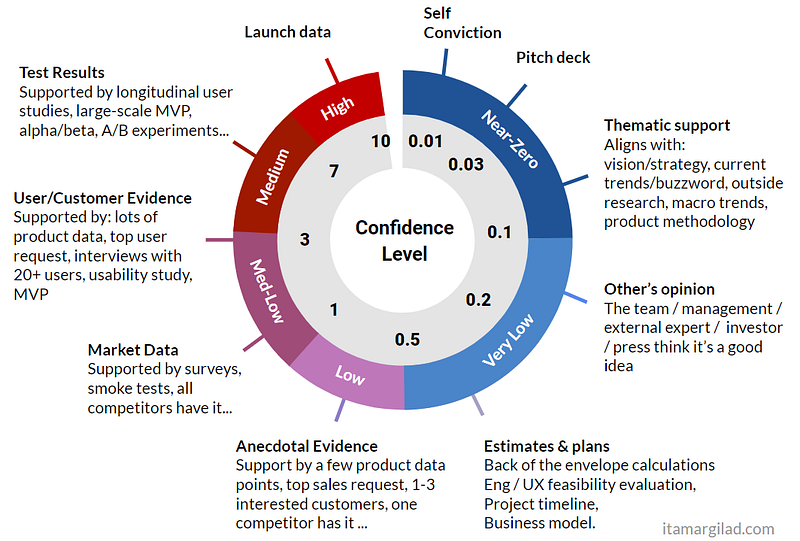 The confidence meter tracks how validated an Idea is, from early hypothesis through to proven solution. Ideas graduate to higher confidence as Steps provide evidence.
Every Idea starts with low confidence. You have a hypothesis, but no evidence. As you execute Steps—user research, prototypes, A/B tests—confidence increases or decreases based on what you learn.
The confidence meter typically tracks:
- ICE scoring (Impact, Confidence, Ease) for initial prioritisation
- Evidence collected through Steps
- Confidence level updated as learning accumulates
An Idea that started at 30% confidence might reach 70% after successful prototyping, then 90% after a positive A/B test. Or it might drop to 10% when user research reveals the problem wasn’t what you thought.
This concept is genuinely useful, especially as a counter to HiPPO (Highest Paid Person’s Opinion) decision-making. When executives push for their pet idea, you can point at the confidence meter: “That idea is at 20% confidence. We need to run Steps to validate it before committing engineering resources.”
How GIST Maps to RoadmapOne
Here’s the practical translation:
| GIST Layer | RoadmapOne Equivalent | Where It Lives |
|---|---|---|
| Goals | Objectives | RoadmapOne roadmap grid |
| Ideas | Key Results | RoadmapOne objectives with RICE/BRICE scores |
| Steps | Discovery sprints / validation work | RoadmapOne WIP allocation + JIRA |
| Tasks | Stories, tickets | JIRA via integration |
In RoadmapOne, we define Objectives (Goals in GIST terminology) and Key Results that the team will deliver. Key Results map to the Ideas that have graduated through validation—they’re the solutions you’ve committed to pursue.
Steps and Tasks belong in JIRA. RoadmapOne is the planning layer; JIRA is the execution layer. That separation matters because boards and executives shouldn’t be drilling into Steps and Tasks. They care about Goals and which Ideas (now Key Results) are being pursued.
When GIST Adds Value
During Product Discovery
GIST’s mental model is valuable when you’re exploring a problem space. The discipline of generating multiple Ideas per Goal, then validating through time-boxed Steps before committing, prevents premature convergence on solutions.
If your team tends to jump from “we need to reduce churn” straight to “let’s build feature X,” GIST’s intermediate layers force better thinking.
When Fighting HiPPO Decision-Making
The confidence meter gives you ammunition. When leadership demands immediate investment in their favoured approach, you can respond with process rather than politics: “We agree that’s worth exploring. Let’s run a two-week Step to validate the assumption. If confidence reaches 60%, we’ll commit engineering resources.”
This reframes disagreement as “we need more data” rather than “I think you’re wrong.”
For Teams Without Any Planning Framework
If your organisation has no structured approach to product planning—no OKRs, no prioritisation framework, no discovery discipline—GIST provides a complete package. It’s better than chaos.
When GIST Adds Overhead
If You Already Have OKRs
Goals are just Objectives. If you already have OKRs , you have this layer. Adopting GIST means retraining everyone on new vocabulary for the same concept.
If You Already Have Prioritisation Frameworks
The Ideas layer with ICE scoring is essentially what RICE , BRICE , or PIE already do. GIST bundles prioritisation into its framework, but if you already have a working prioritisation approach, GIST’s version isn’t better.
If You Already Have JIRA
Steps and Tasks are sprint planning and backlog management. JIRA (or your equivalent) already handles this layer.
The risk is that GIST encourages product teams to own the full hierarchy—including Steps and Tasks—when that execution detail should live with delivery teams. Product leaders should focus on Goals and Ideas (Objectives and Key Results), not micromanaging task breakdowns.
GIST’s comprehensive scope can accidentally pull PMs into the weeds.
The Confidence Concept Without the Full Framework
You don’t need GIST to benefit from confidence tracking.
In RoadmapOne, you can track Confidence as part of BRICE scoring and update it as evidence comes in. A Key Result that started at 50% Confidence because it was a hypothesis becomes 80% Confidence after customer interviews and prototype tests. The BRICE score updates, the prioritisation shifts. Same outcome, simpler framework.
The useful discipline is permission to change your mind as you learn. Update Confidence scores when you have new evidence. Ideas that validate get more resources. Ideas that invalidate get killed. That’s the confidence meter concept without GIST’s full ceremony.
Practical Implementation
If GIST’s mental model appeals to you, here’s how to get the benefits without the overhead:
Use GIST thinking during discovery. When exploring a problem space, explicitly generate multiple Ideas per Goal. Design time-boxed Steps to validate assumptions. Track confidence as evidence accumulates. This is good product management regardless of what you call it.
Map outputs to OKRs + RoadmapOne. Once Ideas validate and you’re ready to commit, Goals become Objectives and validated Ideas become Key Results. Load them into RoadmapOne for capacity planning and roadmap visualisation.
Keep Steps and Tasks in JIRA. Execution-level detail belongs in your delivery tooling, not your strategic planning layer. Use the JIRA integration to connect planning and execution without duplicating work.
Don’t adopt GIST as your operating system. Use its mental model. Reference its confidence meter concept. But don’t introduce four new terms for concepts your organisation already understands under different names.
GIST vs OKRs + RICE: Feature Comparison
| Capability | GIST | OKRs + RICE/BRICE |
|---|---|---|
| Strategic outcomes | Goals | Objectives |
| Solution hypotheses | Ideas (ICE-scored) | Key Results (RICE/BRICE-scored) |
| Validation tracking | Steps + confidence meter | Confidence dimension in scoring |
| Execution | Tasks | JIRA/sprint backlog |
| Industry adoption | Limited | Widespread |
| Stakeholder familiarity | Low | High (OKRs especially) |
| RoadmapOne support | Via manual mapping | Native support |
The capability overlap is substantial. GIST packages these concepts differently but doesn’t add fundamentally new capabilities that OKRs + prioritisation frameworks lack.
The Bottom Line
GIST is a coherent framework that solves real problems: feature factories, HiPPO decision-making, premature commitment to solutions. If you have no planning framework at all, GIST is better than nothing.
But for most organisations, GIST solves problems that are already solved. OKRs give you Goals. RICE/BRICE/PIE give you Ideas prioritisation with confidence tracking. JIRA gives you Steps and Tasks.
The confidence meter concept is genuinely useful—every product person should understand it, especially when dealing with stakeholders who just want to ship their favourite idea without validation. But you can apply that concept without adopting GIST’s full vocabulary.
My recommendation: use GIST’s mental model during discovery to structure your thinking. Generate multiple Ideas per Goal. Design time-boxed Steps. Track confidence as you learn. Then map the outputs into OKRs + RoadmapOne for planning and JIRA for execution. Take the useful ideas; skip the extra terminology.
References
- Itamar Gilad, Why I Stopped Using Product Roadmaps and Started Using GIST Planning — Original framework description
- OKRs for Product Teams — RoadmapOne’s guide to Objectives and Key Results
- BRICE Prioritisation — Prioritisation with confidence tracking
- JIRA Integration — Connecting planning and execution layers
- Objective Prioritisation Frameworks — Complete guide to all 17+ frameworks